5 Language games for buzzing brains

These language games are great for developing and expanding a child’s vocabulary. Most are adaptable to children of different ages and the most equipment you’ll need is pencil, paper and a large imagination!

Amazingly, elephants only leave the house when the sun shines brightly in the sky. But when it rains, they choose to wear spotty underpants and hide under the blankets. Cold weather makes them sad and sluggish. During the winter, they hibernate in dens made out of duvets and old clothes.’

  1. Alphabet Sentences: This is a great game for playing round the breakfast table or even on a long car journey and is VERY simple for all but the very youngest children. Each player must take it in turns to say a sentence. Each sentence must continue on from the last sentence spoken, BUT each sentence must begin with the next letter in the alphabet (see the example above.) The game can stop once you reach the end of the alphabet, or you can go round again! Great for: young readers becoming familiar with letter sounds, or older children looking to expand their vocabulary. Level up: by challenging players to insert interesting adjectives, adverbials or clauses into their sentences.
  2. Rhyming Nonsense: Start off with one person thinking of a word. This word should be fairly short and simple, as this is a great game for younger children. For example, the word ‘cat.’ Each person then has 1 minute to write down as many words that they can think of which rhyme with this word. So, you might end up with a list which includes ‘sat, mat, hat, bat, rat, fat,’ etc.Next, everyone takes a piece of paper and has 5 minutes to write down sentences that include each of these words; the sillier, the better! You should end up with something like this: ‘As I sat on the mat, wearing my stripey winter hat, I thought I saw a bat. The bat had chased a rat, which was speckled, white and fat…’ If you are playing with younger children, then this game can be all done verbally instead.
  3. Mystery Object Game: This is a game which works well in different situations, where you’re at home, on a car journey, or sitting on a beach. It’s a slightly different take on I-Spy, where each person takes it in turns to use adjectives to describe an object that they can see. So, if I were thinking of a tree I might start off by saying ‘tall’ and then I might choose ‘rough‘ to describe the feel of its bark. Try to leave more obvious adjectives – such as those of colour – until the end, as they tend to give the game away too easily!
  4. Fronted Adverbials: Fronted adverbials are words or phrases that come at the start of a sentence and tell us something about when an action took place, where it took place, how often and the manner in which it happened. Put simply, each player works to create one story, where each sentence begins with a fronted adverbial. This works better with older children, but for younger ones you can have a prepared list of adverbials to chose from. Your story could sound something like this: Every Tuesday morning, I take my sloth for a walk in the park. Last week, we were walking by the duck pond when we had a big surprise. Out of nowhere, appeared a giant pink rabbit…’
  5. Fortunately/Unfortunately: This game is an old favourite and a great one for having everyone collapsing in giggles! It also helps children to think about the links between sentences and gets them talking (and writing) at greater length, with multi-clause sentences. Again, the aim is a collective story, but each sentence has to start off – in turn – with ‘fortunately’ or ‘unfortunately.’ For example: ‘Fortunately, the weather today is fine, so we can picnic outside. Unfortunately, our neighbour has just lit a bonfire and we’ll have to move inside. Fortunately, the food is delicious…’

Quick, crazy grammar game!

This is my 8 year old’s Minecraft-themed sentence from when we played this game earlier today. As you can see, we have broken the rules by allowing extra adjectives. I’m also taking his word for it that ‘blaze’ qualifies as a noun, as I have no idea what it is…!

Try out this quick family game which challenges your verbal skills, as well as your grammar.

  1. Each family member has to say a sentence which follows the pattern: Noun, verb, adverb, adjective. For example, I might start by saying, ‘Mark (proper noun) walked (verb) quickly (adverb) in the quiet (adjective) garden.
  2. Keep going round, challenging each other to see who can invent the funniest sentences which follow the same pattern. If someone omits a word class, then they are out and the game continues until you have a winner. ‘Prizes’ can also be awarded for the funniest, most inventive sentences.

Make it simpler by reducing/changing the word classes e.g. Noun, verb, adverb.

Make it trickier by adding extra elements e.g. your sentence has to end with a prepositional phrase – ‘in the quiet garden’ would be an example of this. Or you could challenge yourselves further by only allowing adverbs/adverbial phrases that don’t have an -ly ending.

Make it crazier: by adding a theme to your sentences. For example, you could make all your sentences Minecraft-related, ‘The creeper crept stealthily towards the fat pig.’

Fit it into your routine by challenging each other around the breakfast table/the dinner table/on a car journey/when out for a walk.

‘Working wall’ ideas at home

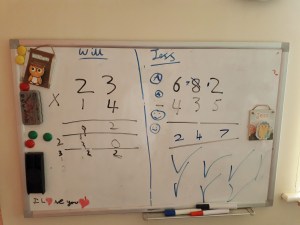
(Our ‘working wall,’ complete with solved subtraction and multiplication. The ticks are my daughter’s self-congratulatory add-on and the As she’s copied from her school marking policy, meaning she has achieved her learning objective…!)

This is our ‘working wall’ in our kitchen (yes, it’s basically just a whiteboard…). We use it for all sorts of things, but in the summer holidays it gets used a lot, mainly for working through maths problems. I mentioned using a whiteboard or other ‘shared space’ in a previous post ‘How to beat the summer holiday slump’ because it works particularly well for my children. If you have a child who lacks confidence in a particular area – one of mine is sure that they’re bad at maths – then it can be really difficult to try and offer them extra help at home. I often found that it became a battleground, with a stubborn and increasingly frustrated me facing off against a stubborn and increasingly frustrated child. The result was that said child would suddenly pretend to forget even the most basic mathematical knowledge: Me: ‘Let’s start here. What’s 5 X 2?’ Child:’ I don’t know.’ Me: ‘You do know. 5 lots of 2?’ Child: ’26? 130? 7?!!’

Needless to say, this  never ended well. Trying to get my child to sit down formally and work through problems together was not going to be the way to improve confidence or ability in maths. What he needed was a different approach. Putting a problem a day on the whiteboard has yielded much better results for us, particularly during the school holidays, when the children haven’t already endured a day’s schooling. It’s a ‘light touch’ approach. I often put a problem there, for each of them, tell them it’s there and then wander into the kitchen a short while later to find out that they’ve already solved them. As they’re not sitting down at a table, they don’t feel like they’re working and as I’m not leaning over their shoulders watching them, there’s no battle and therefore less resistance to learning.

Next time: ‘working wall’ literacy ideas.


Word Hunt challenge

An easy idea to improve literacy skills. Challenge your child to see:

Who can make the longest word?

Who can make the most words?

Words must be in the Oxford English dictionary and proper nouns are excluded. To make the challenge more tricky, try to use each letter only once.

Add your answers in the comment box below to see who has hunted the most/longest words!


a

e

t

o

m

c

s

i

5 ways to beat the summer holiday slump

20180731_103233

(image has absolutely nothing to do with the article. It’s our wedding anniversary today, and this was my present from my husband…)

Summer holidays are great, aren’t they? I used to crave them all year long when I was teaching full-time and, although they take on a slightly different tone with 2 small (-ish) children to entertain, they are still a very welcome release after weeks of work, homework, endless nagging, managing everyone’s social schedules and the feeling that you’re running very hard just to stay in the same place.

However, 6 weeks is a long time in the life of a primary school child and it often seems like feast or famine where learning is concerned: they work very hard from September to June, then grind to a sudden halt for the duration of the summer holidays.

Now, I am definitely not an advocate of summer schools for children. I am not even very keen on private tuition over the holidays. I do believe that play and exercise and being outdoors and developing socially are just as important as more formal learning. Beating the ‘summer slump’ doesn’t need to involve sitting down at a desk, pencil in hand, nor do you need to spend any money or a great deal of time. The best way to ensure the hard work that your child and their teacher has put in over the year isn’t lost over the summer is to make learning an integral part of what you do as a family. So with that in mind, here are 5 ways to beat the summer slump:

1) Go shopping. (Go on, it’s for the good of the children, honest…!) Talk to your child about how much items cost. Ask them simple questions, depending upon their age, for example, ‘Which of these items costs more?’ (for a younger child) or ‘If I buy this item, how much change will I get from £5?’ So much of what we buy these days is paid for using cards, but try to ensure that children are given cash to use as much as possible, so that younger ones become familiar with the coins and see the ‘real-word’ uses of mathematics.

2) Talk about time. The school day is governed by time, with break, lunch and home time at set intervals, so much so that children often become lazy about reading time for themselves. One question I’m often asked at school is, ‘How long is it until break/lunchtime?’ Children have a natural curiosity about time which can be exploited: my daughter is fond of asking how many days it is until her birthday, so we have made charts together where she can tick off the days and this can lead to a chat about how many days there are in a week, weeks in a month, etc… The same idea can be used for your summer holiday: draw tick charts to count off the days, talk about different time zones if you go abroad, or just very simply ask your children to tell you the time on an analogue clock. Talk aloud about what time you are doing various activities together and how long it is until then.

3) Have a whiteboard in the kitchen/shared family space. This may be a board that you use for shopping lists, or family notices or doodling. Ours sits on our wall in our kitchen and has been an invaluable learning tool. Use it for family games of ‘hangman’ to help with spellings, draw word searches on it, write sentences with missing words to help with vocabulary development, put the occasional maths problem on it to solve together as a family. Make sure that your children see Mum and Dad learning too: get them to challenge you in this shared space.

4) Use the summer holiday time to explore books. Often, during term-time, children get stuck just reading their school book, as there’s often precious little time for anything else. If these are uninspiring (Biff, Chip, Floppy and the flippin’ magic key, anyone…?!), then it is very easy to see how they can be turned off reading at a young age. Children often say that they dislike reading when really they just haven’t found the right books yet. Use the summer holidays to explore what their interests. As a teacher, I have never been too fussed about WHAT children are reading. If they like comics, let them read comics, if they like Minecraft, let them read gaming books and magazines. Expanding their range can come later, for now, just get them reading. Use your local library and make sure that you talk to your children about what they are reading: ask them to explain the story to you, describe their favourite character, or how to get an exploding arrow (Minecraft, and we haven’t managed it yet…)

5) Do some science. Get out and explore nature. Look for bugs in their natural habitat – ladybirds always seem to be favourite here. Keep a tally chart to see how many you find. Make some observations about where they like to live. Predict what sort of creatures you’ll see on sunny days versus rainy days and test your hypothesis. Use lemons to make invisible ink, look at shadows and sunlight at different times of the day. Check out http://www.scienceboffins.co.uk, which has some great experiments.