5 Language games for buzzing brains

These language games are great for developing and expanding a child’s vocabulary. Most are adaptable to children of different ages and the most equipment you’ll need is pencil, paper and a large imagination!

Amazingly, elephants only leave the house when the sun shines brightly in the sky. But when it rains, they choose to wear spotty underpants and hide under the blankets. Cold weather makes them sad and sluggish. During the winter, they hibernate in dens made out of duvets and old clothes.’

  1. Alphabet Sentences: This is a great game for playing round the breakfast table or even on a long car journey and is VERY simple for all but the very youngest children. Each player must take it in turns to say a sentence. Each sentence must continue on from the last sentence spoken, BUT each sentence must begin with the next letter in the alphabet (see the example above.) The game can stop once you reach the end of the alphabet, or you can go round again! Great for: young readers becoming familiar with letter sounds, or older children looking to expand their vocabulary. Level up: by challenging players to insert interesting adjectives, adverbials or clauses into their sentences.
  2. Rhyming Nonsense: Start off with one person thinking of a word. This word should be fairly short and simple, as this is a great game for younger children. For example, the word ‘cat.’ Each person then has 1 minute to write down as many words that they can think of which rhyme with this word. So, you might end up with a list which includes ‘sat, mat, hat, bat, rat, fat,’ etc.Next, everyone takes a piece of paper and has 5 minutes to write down sentences that include each of these words; the sillier, the better! You should end up with something like this: ‘As I sat on the mat, wearing my stripey winter hat, I thought I saw a bat. The bat had chased a rat, which was speckled, white and fat…’ If you are playing with younger children, then this game can be all done verbally instead.
  3. Mystery Object Game: This is a game which works well in different situations, where you’re at home, on a car journey, or sitting on a beach. It’s a slightly different take on I-Spy, where each person takes it in turns to use adjectives to describe an object that they can see. So, if I were thinking of a tree I might start off by saying ‘tall’ and then I might choose ‘rough‘ to describe the feel of its bark. Try to leave more obvious adjectives – such as those of colour – until the end, as they tend to give the game away too easily!
  4. Fronted Adverbials: Fronted adverbials are words or phrases that come at the start of a sentence and tell us something about when an action took place, where it took place, how often and the manner in which it happened. Put simply, each player works to create one story, where each sentence begins with a fronted adverbial. This works better with older children, but for younger ones you can have a prepared list of adverbials to chose from. Your story could sound something like this: Every Tuesday morning, I take my sloth for a walk in the park. Last week, we were walking by the duck pond when we had a big surprise. Out of nowhere, appeared a giant pink rabbit…’
  5. Fortunately/Unfortunately: This game is an old favourite and a great one for having everyone collapsing in giggles! It also helps children to think about the links between sentences and gets them talking (and writing) at greater length, with multi-clause sentences. Again, the aim is a collective story, but each sentence has to start off – in turn – with ‘fortunately’ or ‘unfortunately.’ For example: ‘Fortunately, the weather today is fine, so we can picnic outside. Unfortunately, our neighbour has just lit a bonfire and we’ll have to move inside. Fortunately, the food is delicious…’

Quick, crazy grammar game!

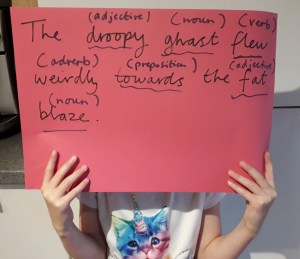
This is my 8 year old’s Minecraft-themed sentence from when we played this game earlier today. As you can see, we have broken the rules by allowing extra adjectives. I’m also taking his word for it that ‘blaze’ qualifies as a noun, as I have no idea what it is…!

Try out this quick family game which challenges your verbal skills, as well as your grammar.

  1. Each family member has to say a sentence which follows the pattern: Noun, verb, adverb, adjective. For example, I might start by saying, ‘Mark (proper noun) walked (verb) quickly (adverb) in the quiet (adjective) garden.
  2. Keep going round, challenging each other to see who can invent the funniest sentences which follow the same pattern. If someone omits a word class, then they are out and the game continues until you have a winner. ‘Prizes’ can also be awarded for the funniest, most inventive sentences.

Make it simpler by reducing/changing the word classes e.g. Noun, verb, adverb.

Make it trickier by adding extra elements e.g. your sentence has to end with a prepositional phrase – ‘in the quiet garden’ would be an example of this. Or you could challenge yourselves further by only allowing adverbs/adverbial phrases that don’t have an -ly ending.

Make it crazier: by adding a theme to your sentences. For example, you could make all your sentences Minecraft-related, ‘The creeper crept stealthily towards the fat pig.’

Fit it into your routine by challenging each other around the breakfast table/the dinner table/on a car journey/when out for a walk.

Back to school

It’s been a long time – 10 months according to my blog stats – since I have done more than merely contemplate writing another post. Instead, with both children now at school, I’ve immersed myself in re-learning how to teach after 6 years off from the profession: not this time as a teacher, but as a TA (with a little bit of teaching thrown in …!) at my children’s lower school.

When I left teaching  to be a full-time mother, I had begun to fall out of love with the job. I say ‘job’ and not ‘profession’ because I believe that the profession of teaching is and always will be an honourable and exciting one: working with children and young people who make every day different and challenging, trying to inspire a love of knowledge and exploration that will be life-long and in turn being challenged, inspired and constantly surprised by the children you work with. However, this was no longer the job that I found myself doing. There was little or no choice in what could be taught in the classroom: where I taught – in an Upper school – the curriculum in Years 10-13 was dictated by GCSE and A Level syllabuses and in Year 9 by the abysmal SATS. Not only was professional judgement restricted by external tests, but – because of the pressure put on schools – it was also ham-strung by various internal assessment tests, which meant that I felt like some kind of glorified data-entry clerk.

Moreover, the tests produced the kind of data which was easy to reproduce in graphs and tables and percentages. Try fitting ‘James has worked hard this term to improve his spelling and punctuation. To improve further, he now needs to support all his points with evidence from the text’ into a spreadsheet, then convert it into a some kind of quantifiable score. Oh, and then remember that James lives in house with two parents who have mental health issues and he gets up every night to see to his baby brother when his parents aren’t able to. Quantify that.

I don’t know if I expected primary education to be different. If I’d really thought about it, I’d have probably realised that it was unlikely to have escaped the endless onslaught of quantification. It hasn’t. Phonics – although not without its merits in the very early stages of reading and writing – is beloved of governments because of its easily quantifiable nature. How many letter sounds/digraphs does a child know? Can they blend and segment? Can they – my least favourite thing to do with phonics – identify ‘alien’ words and real words? Tick! Tick! Tick! Enter a  number in a spreadsheet and out comes verifiable progress (!)

This continues further up the school, where 6 and 7, 8 and 9 year olds are now required to identify parts of speech that most of my A Level students couldn’t identify – and some of which are still up for debate amongst professional linguists. Experiencing this as a parent as well as a teacher makes it both professionally and personally frustrating. I work in an amazing school, with committed and professional staff who teach lovely, creative and enthusiastic children. If only the ‘profession’ could be treated as ‘professionals’ – people who are more than capable of designing, implementing and assessing their own curriculum. Perhaps then we would view government interference in the curriculum with the same shock and aversion as we would do if they suddenly started telling doctors what to prescribe their patents and measuring their progress by how quickly they recovered from bouts of ‘flu or chicken pox.

At the moment, government and –  because of the way this ‘trickles down’ – a significant proportion of the general public, view the teaching profession in a similar way to my six year old who, when I referred to what I did as ‘work’ said, ‘That’s not work! You don’t work, Mummy. Daddy goes to work.’ Clearly a future politician in-waiting…

Starting school: The (terrified) parents’ guide…

BackToSchool

Nervous about starting school in September? Worried how you’ll cope with a new routine and different faces? Scared about the demands and expectations that will be placed upon you? Then chances are, you’re probably a parent, not a child. Whilst a child’s first day at school is a huge milestone for parents, for most children it’s as big a deal as their parents choose to make it. We run around buying uniform, attending information evenings, having earnest chats with our children’s prospective teachers about why our child in particular is a special case and on the day itself we take photographs,  say anxious goodbyes in the classroom and walk around for the rest of the day feeling like we’ve lost a limb. Worse still, with our modern-day tendency to think, where previous generations would just have done, we torment ourselves by reading studies which helpfully suggest that: summer-born children will be adversely affected by starting school ‘early’/those parents who don’t read enough with their children are condemning them to a life of illiteracy/we must have a thorough and detailed knowledge of the merits of synthetic phonics versus ‘look and say’ before our child sets foot over the threshold of the classroom. I’ll save the rant about our modern-day obsession with ‘knowledge’ for another blog. Suffice it to say, that if we were as adept at assessing the quality and validity of the studies we read as we are at scaring the hell out of ourselves with them, then we would all be much happier human beings.

My son started school in a reception class at our local Lower School last September. And no – I’m not claiming that I walked him to school on his first day with some sort of Zen-like calm. Did I have doubts about his ability to cope with this? Yes. Was I worried for him? Yes. Did my stomach feel as if a hundred wriggling, writhing worms had taken up residence? Yes. My son’s only experience of any care outside the family up until his entrance to school was 3 mornings a week at the local pre-school. Until he began school he had never done a full day, never had the experience of eating lunch away from home, and still needed my help to dress himself in the mornings. So I worried about him going hungry, changing for P.E., going to the toilet – all the usual things.

Was my son worried? He certainly didn’t appear to be. I expected tears (to this day, there have been none), refusal to go (the most I have ever got is a jokey ‘I don’t want to go to school today’) and anxiety. What I got was tiredness (to be expected), a little grumpiness for the first half term and overall a boy who seemed happy and settled. True, my son had the advantage of moving up to reception class with nearly all the children he knew from our village pre-school, but in other ways he was probably less prepared than your average 4 year-old, in that he had been largely at home with me since the day he was born.

So what is being in a reception class like? Well, much has been written in the press recently about how in this country we force children to start school too young. This time last year, full of fears for my son, I might even have agreed with this point of view. And whether you agree with this statement or not really depends on how we define formal schooling. In my son’s school, reception class is part of the main school, but in some schools it can take place in a quite separate building. Either way, the curriculum followed is quite separate. If you have been sending your child to a pre-school or to a private nursery prior to them starting  school then the curriculum they follow in reception class is merely a continuation of this. They continue to follow the EYFS (Early Years Foundation Stage) and don’t begin to follow the National Curriculum until they are in Year 1. Granted, they attend all day, every day, but many children in private nurseries already have experience of this and those that don’t – as my son didn’t – tend to adapt fairly quickly.

Through volunteering in my son’s class, I have been able to experience what a reception class day is like and it’s pretty far away from the idea of ‘formal schooling’ that I had this time last year. My son’s class will start the day by finding their name tags – this has now progressed to writing their names – and then sitting down on the mat to register. They answer their names, give their lunch preferences – packed or school dinners, meat or vegetarian. Then there’s time for show and tell, based around their current topic. They then have a short amount of whole class teaching – phonics or numeracy – before breaking off into small groups to work on a play-based learning activity. Last week, the group I was in charge of were playing bingo – cue much shouting and laughter – but in previous weeks we have been drawing numbers on chalk in the playground, filling up beakers with water and sand to learn about ‘capacity’, making shapes out of straws and opening up a ‘play shop’ for the rest of the class. Most of the time, the children aren’t really aware they’re learning: they’re far too busy having fun.

After their group-based activity, the children are allowed ‘choosing time.’ This means exactly what it says: they can play inside – dolls, Lego, listening to music, watching birds from the window – or outside – climbing frame, slide, scuttle-bugs, ball games. They can even go and visit friends in the other reception class if they chose to. This pattern is repeated pretty much throughout the days and weeks. Yes, there are ‘assessments’ of reading and numeracy but the children aren’t aware these are taking place. They laugh, they play, make friends, fall out with friends, learn to share, and, yes, somewhere in all that they may also learn to read and write. To my eyes, it appeared to happen by osmosis, by magic, but I think it’s probably down to the skill of the teachers…

So, what I’m trying to say is don’t worry. Of course you will worry, but trust me – reception year is as far from formal schooling as driving a car is from flying a fighter jet. Oh, and I say this as the mother of a girl who will be starting reception class this September, who was born on August 30th, scraping into the academic year by just 24 hours and who was ‘meant’ to be a September-born baby…

For those who prefer practical action to worry, here are some things you can do:

1) If you haven’t already done so, visit your child’s school. If possible, ask to sit in on a reception class to see what type of expectations will be placed on your child . Most of us will have no memories of what school was like at this age and this should help to reassure you!

2) Try not to pass any worries you have onto your child. Most parents view starting school as such a milestone that we have the potential to create anxieties in our children where there were none. Pretty much, children will respond to situations the way they see us do. So by all means, take pictures, make an occasion of buying school shoes, but don’t spend the summer constantly talking about school in the hopes that this will prepare your child, when all it will probably do is alert them to your anxiety.

3) If your child isn’t transferring to school with children they already know, then it may be worthwhile trying to organise a play-date with a child who will be in their class, so they have at least one familiar face. You will usually meet other parents at some sort of information evening before school breaks up for the summer.

4) Don’t worry if your child can’t write or read before they start: this is what school is for! Some nurseries or pre-schools do focus on these skills, but my son’s didn’t – largely because his school teaches cursive and prefers a ‘clean slate’ to work with! As a result, my son arrived in September, able only to write a ‘w’ for his name. Now, he can write beautifully (joined up – I am a most unexpected convert to the teaching of cursive!) and actually enjoys writing. He can read well and – most importantly – is completely unaware of having been ‘taught’ these skills.

5) You can, however, help your child – and their prospective teachers! – if you ensure that they are prepared in other ways for school. If your child doesn’t already do this, it may be a good idea to spend some time over the summer gradually getting them to dress and undress themselves, to take some responsibility for putting their clothes away and to learn how to wipe their nose (!) and use a shared toilet properly. It’s these self-care skills that will matter more to your child’s teacher than whether they can read or write come September. Children in my son’s class have to have responsibility for their coat and P.E. kit (putting them away, taking them home), their book bag and their water bottle. This will take time, things will get lost and forgotten and muddled up – my son and another boy spent most of the first term accidentally, repeatedly, swapping identical pairs of black, Clarks school shoes back and forth, until one of them had a growth spurt and changed sizes – but if they’re used to taking responsibility at home, then the transition will be much easier.

6) ….and RELAX. We all did it, we survived (and that was in the 70s and 80s, when our parents let us ride with no seatbelts and go out without sunscreen…) Thanks, Mum.  😉

5 ways to help your child learn to read (without them even realising)

As an English teacher and the mother of a boy in reception class, I know how hard it can be to strike the balance between supporting your child – and their teacher – with their early learning and becoming the sort of scary, deranged tiger-Mummy that teachers dread meeting on consultation days. Here are just 5 things – as both a mother and a teacher –  that I have found to be useful:

1. Don’t ‘help them with their reading’

Never ask your child to sit down and ‘do his/her reading with you’. This is likely to engender the same emotional response as someone asking me to sit through 90 minutes of grown men passing a ball back and forth to each other’s feet, as well as the same slim chance of it actually happening. The main thing wrong with this approach is that it treats reading as if it were some kind of separate activity – something that is divorced from the child’s every day life – instead of something which should be an integral part of it. (though if you do make this beginner’s error and are met with the same response I was: ‘Noooo! Never!’ the situation can be remedied by asking the child’s 3 year old sister if she would like to practise her letter sounds.) Because sometimes, just sometimes,  sibling rivalry works in your favour…

2. Try to protect ‘reading for pleasure’

This can be tough early on, when they know so few words.Most schools will provide some sort of reading log or journal, which is sent home with a book/s and phonics cards and this means that even at this early stage there is some expectation for parents to sit down with their child to ‘practise’ what they have learnt that week. In my experience, it is best to do this – from the child’s perspective – as informally and unconsciously as possible.

My child’s school sends home two books each week: one is usually from the Oxford reading scheme and one is a book that the child has chosen his/herself from their classroom. So, if your child – like mine – has books sent home every week from school, I tend to leave the ‘learning reading’ book in the bag and enjoy the ‘story’ book together. This way, my son will happily ‘read’ the words he knows when he has chosen the book himself and enjoys the story. Moreover, it gives him the added motivation to learn more, as he sees the link between reading and pleasure. Most schools will read the ‘learning reading’ book with each child once a week at school and the scintillating antics of Mum Bug – if you’re not yet familiar with this, then you’re in for a treat –  and her bag only seem to stretch so far…! Doing this hopefully ensures that the reading you and your child share is always something that they enjoy, rather than a chore.

3. Play lots of games and keep it casual

We all know that children learn best through play, when learning is not a conscious activity. Primary teachers – particularly those in the earliest years – recognise this and most learning in reception classes and Year 1 takes place through play-based activities. Parents sometimes forget this when it comes to helping their children with reading, so here are a few words and sounds based activities which I have found my little boy is more than willing to engage with:

* Phonics treasure hunt – use phonics flash cards (letter sounds) to make a treasure hunt around the house. Children can use the cards to make CVC (consonant-vowel-consonant) words when they have completed the hunt. (NB: real treasure – of the chocolate-based variety – was an essential in our house when we played this game…)

* Out and about/phonics eye spy – Ask your child to look out for objects that begin with a certain letter sound whenever you go out. You could pick one sound each trip and just focus upon that, or mix it up a bit with different sounds. A phonics-based eye spy is also a good alternative.

* Go fish – The old, gold, favourite game works well with magnetic plastic letters and mini fishing rods. You can ask them to fish for specific sounds and then use them to spell out CVC words.

*Bath phonics – use bath pens to write letters and sound them out and then spell out CVC words. (Apologies, this is a messy one…!)

*Whiteboard – have a whiteboard in a communal space with magnetic letter sounds or key words. Let the child explore this themselves without direction unless they ask for help. A nice, fat marker pen always seems to help entice them…!

*iPad – for those of you who don’t disapprove of the inevitable combination of iPads and under 5s there are some clever apps out there that can help children learn. In our house we love the Alphablocks app and Jolly Phonics letter sounds. Again, this works best if you just leave them on the iPad without mentioning they’re there (and it also saved me from hearing a few hundred renditions of Princess Sofia and her bloody princess bloody perfect slumber party) Apparently, that’s not the official name of the app…

4. Don’t start too early

I have friends who started introducing phonics to their children before they started school. I didn’t – largely at the time because I was unsure of how my son’s school would teach it and wanted to avoid any possible confusion – and my son attended a preschool who had a child-led policy of only introducing letter sounds if a child showed a curiosity about reading. It was only after attending a phonics evening at my son’s school and helping out in his classroom that I actually felt as if I had an understanding of how they would approach early reading. Although phonics is a pretty universal – though not uncontroversial – strategy, each school may approach it in a slightly different way, so it’s important to know that any work you do with your child is supporting the teacher’s work, rather than causing confusion.

5. Relax…

Learning to read is not unlike all those other milestones that mothers parents like to beat themselves up over: learning to talk, learning to walk, potty training, sleeping through…Yes, they will get there. No, it’s not a indicator of wider intelligence. Like anything else we try get our children to do, a gentle approach is best, or we risk putting them off for life. So let’s give ourselves a break and remember: reading is a life-long pleasure, not a skill to be measured.