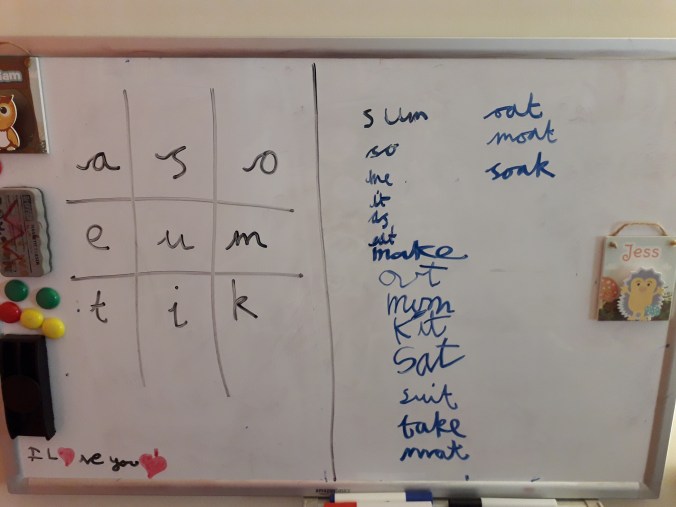
As promised, a literacy-themed ‘working wall’ – word hunt challenge. We are still going – 18 words so far. ‘Mum’ is a bit of a cheat, but I had to let it pass…! How many can you and yours find? What is the longest word you can find?
As promised, a literacy-themed ‘working wall’ – word hunt challenge. We are still going – 18 words so far. ‘Mum’ is a bit of a cheat, but I had to let it pass…! How many can you and yours find? What is the longest word you can find?
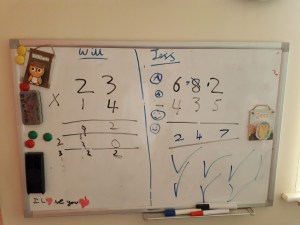
(Our ‘working wall,’ complete with solved subtraction and multiplication. The ticks are my daughter’s self-congratulatory add-on and the As she’s copied from her school marking policy, meaning she has achieved her learning objective…!)
This is our ‘working wall’ in our kitchen (yes, it’s basically just a whiteboard…). We use it for all sorts of things, but in the summer holidays it gets used a lot, mainly for working through maths problems. I mentioned using a whiteboard or other ‘shared space’ in a previous post ‘How to beat the summer holiday slump’ because it works particularly well for my children. If you have a child who lacks confidence in a particular area – one of mine is sure that they’re bad at maths – then it can be really difficult to try and offer them extra help at home. I often found that it became a battleground, with a stubborn and increasingly frustrated me facing off against a stubborn and increasingly frustrated child. The result was that said child would suddenly pretend to forget even the most basic mathematical knowledge: Me: ‘Let’s start here. What’s 5 X 2?’ Child:’ I don’t know.’ Me: ‘You do know. 5 lots of 2?’ Child: ’26? 130? 7?!!’
Needless to say, this never ended well. Trying to get my child to sit down formally and work through problems together was not going to be the way to improve confidence or ability in maths. What he needed was a different approach. Putting a problem a day on the whiteboard has yielded much better results for us, particularly during the school holidays, when the children haven’t already endured a day’s schooling. It’s a ‘light touch’ approach. I often put a problem there, for each of them, tell them it’s there and then wander into the kitchen a short while later to find out that they’ve already solved them. As they’re not sitting down at a table, they don’t feel like they’re working and as I’m not leaning over their shoulders watching them, there’s no battle and therefore less resistance to learning.
Next time: ‘working wall’ literacy ideas.
 Quercus Tutoring