5 Language games for buzzing brains

These language games are great for developing and expanding a child’s vocabulary. Most are adaptable to children of different ages and the most equipment you’ll need is pencil, paper and a large imagination!

Amazingly, elephants only leave the house when the sun shines brightly in the sky. But when it rains, they choose to wear spotty underpants and hide under the blankets. Cold weather makes them sad and sluggish. During the winter, they hibernate in dens made out of duvets and old clothes.’

  1. Alphabet Sentences: This is a great game for playing round the breakfast table or even on a long car journey and is VERY simple for all but the very youngest children. Each player must take it in turns to say a sentence. Each sentence must continue on from the last sentence spoken, BUT each sentence must begin with the next letter in the alphabet (see the example above.) The game can stop once you reach the end of the alphabet, or you can go round again! Great for: young readers becoming familiar with letter sounds, or older children looking to expand their vocabulary. Level up: by challenging players to insert interesting adjectives, adverbials or clauses into their sentences.
  2. Rhyming Nonsense: Start off with one person thinking of a word. This word should be fairly short and simple, as this is a great game for younger children. For example, the word ‘cat.’ Each person then has 1 minute to write down as many words that they can think of which rhyme with this word. So, you might end up with a list which includes ‘sat, mat, hat, bat, rat, fat,’ etc.Next, everyone takes a piece of paper and has 5 minutes to write down sentences that include each of these words; the sillier, the better! You should end up with something like this: ‘As I sat on the mat, wearing my stripey winter hat, I thought I saw a bat. The bat had chased a rat, which was speckled, white and fat…’ If you are playing with younger children, then this game can be all done verbally instead.
  3. Mystery Object Game: This is a game which works well in different situations, where you’re at home, on a car journey, or sitting on a beach. It’s a slightly different take on I-Spy, where each person takes it in turns to use adjectives to describe an object that they can see. So, if I were thinking of a tree I might start off by saying ‘tall’ and then I might choose ‘rough‘ to describe the feel of its bark. Try to leave more obvious adjectives – such as those of colour – until the end, as they tend to give the game away too easily!
  4. Fronted Adverbials: Fronted adverbials are words or phrases that come at the start of a sentence and tell us something about when an action took place, where it took place, how often and the manner in which it happened. Put simply, each player works to create one story, where each sentence begins with a fronted adverbial. This works better with older children, but for younger ones you can have a prepared list of adverbials to chose from. Your story could sound something like this: Every Tuesday morning, I take my sloth for a walk in the park. Last week, we were walking by the duck pond when we had a big surprise. Out of nowhere, appeared a giant pink rabbit…’
  5. Fortunately/Unfortunately: This game is an old favourite and a great one for having everyone collapsing in giggles! It also helps children to think about the links between sentences and gets them talking (and writing) at greater length, with multi-clause sentences. Again, the aim is a collective story, but each sentence has to start off – in turn – with ‘fortunately’ or ‘unfortunately.’ For example: ‘Fortunately, the weather today is fine, so we can picnic outside. Unfortunately, our neighbour has just lit a bonfire and we’ll have to move inside. Fortunately, the food is delicious…’

5 ways to help your child learn to read (without them even realising)

berkocat's avatarQuercus Tutoring

As an English teacher and the mother of a boy in reception class, I know how hard it can be to strike the balance between supporting your child – and their teacher – with their early learning and becoming the sort of scary, deranged tiger-Mummy that teachers dread meeting on consultation days. Here are just 5 things – as both a mother and a teacher –  that I have found to be useful:

1. Don’t ‘help them with their reading’

Never ask your child to sit down and ‘do his/her reading with you’. This is likely to engender the same emotional response as someone asking me to sit through 90 minutes of grown men passing a ball back and forth to each other’s feet, as well as the same slim chance of it actually happening. The main thing wrong with this approach is that it treats reading as if it…

View original post 965 more words

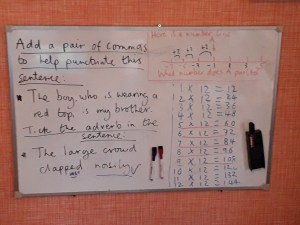
Maths and literacy working wall

Today’s wall sees us:

  • adding a pair of commas to punctuate a sentence with a relative clause;
  • identifying the adverb in a sentence;
  • practising our 12 times table;
  • finding the missing numbers on a number line, which include negative numbers.

Teaching textual cohesion – a starter


Image result for jam sandwich

Making jam and cream sandwiches might be a great way to teach cohesion, but if you’re looking for a less messy, text-based example, then look no further…

This is a great activity for teaching textual cohesion and can be adapted to suit almost any age group, depending upon the text which you choose to use.


  • First of all, get pupils to identity the nouns. Each separate noun can be underlined or highlighted in a different colour.


  • Then, ask them to find the pronouns which link back to those nouns and underline these in the same colour as their corresponding noun.


  • Look at these together and discuss how they help the text make sense. You will find that even very young children will be able to observe this, especially if they are encourage to draw on big sheets with coloured pens, or even use arrows to link pronouns back to their original noun.


  • For more advanced students, you could look at this as a starting point for talking about anaphoric reference.

In this text, the nouns are in bold and the corresponding pronouns in italics, but colours or would make much more sense in the classroom!

Sarah woke early that morning. She got up and dressed quickly, making her bed and tidying away her toys. Before she made her way downstairs, she checked the room carefully to make sure everything in it was perfectly in order.


As she skipped happily into the kitchen, Smudge the cat greeted her with a loud “meow!” He wove himself in between her legs, almost tripping her up, which was his way of asking for his breakfast. Sarah filled his bowl and placed it carefully back on the kitchen floor. From upstairs, she could hear the sound of her parents’ alarm going off. She would have to hurry if she wanted to make breakfast for them!

Quick, crazy grammar game!

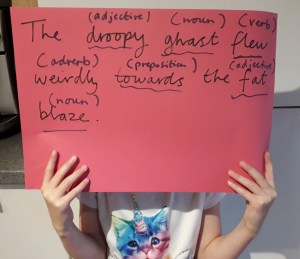
This is my 8 year old’s Minecraft-themed sentence from when we played this game earlier today. As you can see, we have broken the rules by allowing extra adjectives. I’m also taking his word for it that ‘blaze’ qualifies as a noun, as I have no idea what it is…!

Try out this quick family game which challenges your verbal skills, as well as your grammar.

  1. Each family member has to say a sentence which follows the pattern: Noun, verb, adverb, adjective. For example, I might start by saying, ‘Mark (proper noun) walked (verb) quickly (adverb) in the quiet (adjective) garden.
  2. Keep going round, challenging each other to see who can invent the funniest sentences which follow the same pattern. If someone omits a word class, then they are out and the game continues until you have a winner. ‘Prizes’ can also be awarded for the funniest, most inventive sentences.

Make it simpler by reducing/changing the word classes e.g. Noun, verb, adverb.

Make it trickier by adding extra elements e.g. your sentence has to end with a prepositional phrase – ‘in the quiet garden’ would be an example of this. Or you could challenge yourselves further by only allowing adverbs/adverbial phrases that don’t have an -ly ending.

Make it crazier: by adding a theme to your sentences. For example, you could make all your sentences Minecraft-related, ‘The creeper crept stealthily towards the fat pig.’

Fit it into your routine by challenging each other around the breakfast table/the dinner table/on a car journey/when out for a walk.